
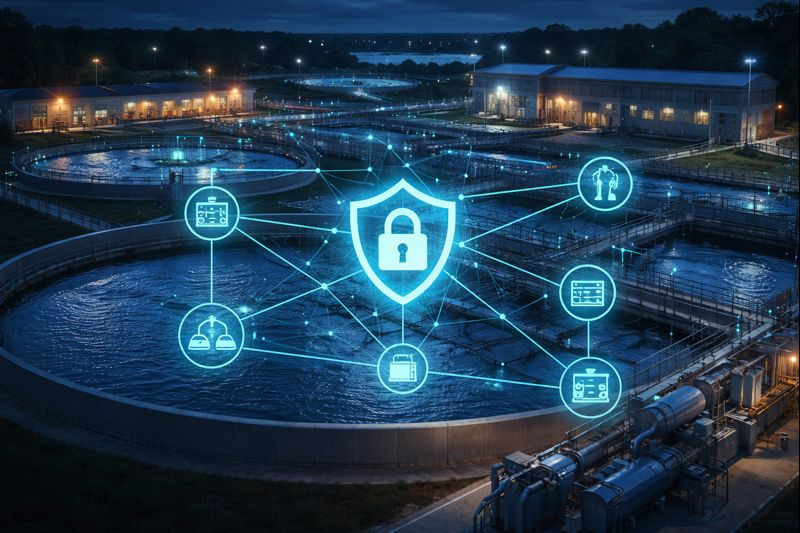
Water Utility Cybersecurity: OT and IoT Risks
Water utilities rely on OT and IoT systems to treat and deliver clean water. These systems control pumps, valves, sensors, and chemical processes. However, as these systems become more connected, cyber risks increase. As a result, attackers now target water infrastructure more often.
Why Water Utilities Are Cyber Targets
To begin with, many water systems use old OT technology. Some devices were installed decades ago. However, these systems still control critical operations.
Additionally, many utilities lack full visibility into connected devices. Therefore, weak points often go unnoticed.
For example, attackers may target remote pumping stations. Moreover, some facilities use shared vendor access. Finally, disruptions to water service affect public safety.
Threat #1: Legacy SCADA and Control Systems
First, water utilities depend on SCADA systems to manage operations. These systems control treatment, pressure, and flow. However, many SCADA platforms lack modern security features.
Additionally, some controllers cannot be patched easily. For example, updates may require system downtime.
As a result, attackers may exploit known weaknesses.
Threat #2: Remote Pump Stations and Field Devices
Secondly, utilities operate many remote sites. These include pump stations, reservoirs, and sensors. However, these locations often have limited security.
In addition, remote devices may use wireless connections. Therefore, attackers can target them from outside the facility.
Consequently, a single compromised device can affect operations.
Threat #3: Chemical and Treatment Process Controls
Thirdly, water treatment plants rely on automated chemical systems. These systems manage chlorine and other treatment chemicals. However, poor access control creates serious risk.
For example, attackers could change treatment levels. Additionally, operators may not notice changes right away.
As a result, public health may be impacted.
Threat #4: Vendor and Third-Party Access
Fourthly, water utilities depend on vendors for maintenance. Vendors often require remote access to OT systems. However, access controls are not always strict.
Moreover, shared accounts are still common. Therefore, tracking activity becomes difficult.
Consequently, stolen credentials can expose critical systems.
How IoT365 Helps Secure Water Utilities
In response to these risks, IoT365 helps utilities secure OT and IoT systems. The platform provides real-time visibility and monitoring.
Additionally, IoT365 supports Zero Trust segmentation. Furthermore, it detects abnormal behavior in real time.
As a result, utilities can reduce risk without disrupting operations.
- Device discovery across SCADA, OT, and IoT assets
- Zero Trust segmentation to limit lateral movement
- Password and firmware checks
- Anomaly detection for unusual commands
- Secure vendor access with identity tracking
Learn More from Trusted Water Security Sources
- CISA Water Sector Cybersecurity: https://www.cisa.gov/water
-
EPA WaterISAC Resources:
Home Page
- NIST Cybersecurity Framework: https://www.nist.gov/cyberframework
Final Thoughts
In conclusion, water utilities must protect OT and IoT systems. However, many facilities still rely on outdated technology.
Ultimately, strong cybersecurity helps ensure safe and reliable water service.
However, OT systems face growing cyber risks.
Additionally, IoT devices increase attack surfaces.
Furthermore, legacy systems are hard to secure.
Moreover, limited visibility slows detection.
For example, one weak device can affect operations.
In addition, vendor access creates new risks.
Therefore, proactive monitoring is essential.
Finally, layered security reduces disruption.
Related OT & IoT Cybersecurity Resources
To learn more about protecting connected environments, explore these related resources from IoT365: